Mar 13, 2026
Temu free prizes
Temu is a Chinese company which offers heavily discounted consumer goods, typically shipped directly from China where most things are manufactured. The general catch is risks to user privacy due to extensive data collection, concerns about unethical labour practices and forced labour in its supply chain and poor or inconsistent product quality.
There is an ongoing widespread scam in which the scammer posing as Temu sends an email which claims that the victim could receive a prize such as a free or heavily discounted e-bike in exchange for answering a few questions about their shopping experience with the brand. The victim will then click on a dodgy website and give their personal data.
Cloud Service Full
Cloud storage is a method of storing digital data on
remote servers, accessible over the internet, rather than on local devices like hard drives. Multiple companies offer a form of cloud service, including Google (Drive), Microsoft (OneDrive) and Apple (iCloud).
Scammers sometimes send messages claiming to be the cloud provider and they inform you that your cloud storage is full and you must pay to upgrade. They can sometimes even claim that you will no longer be able to send messages or that your account will be locked or even deleted if you don’t respond to the message urgently.
If the user was at or over the limit for their storage, the worst-case scenario would be that you may not be able to edit your files or upload new ones, depending on the provider’s methods, but your account would not be locked or deleted.

Winter fuel payments
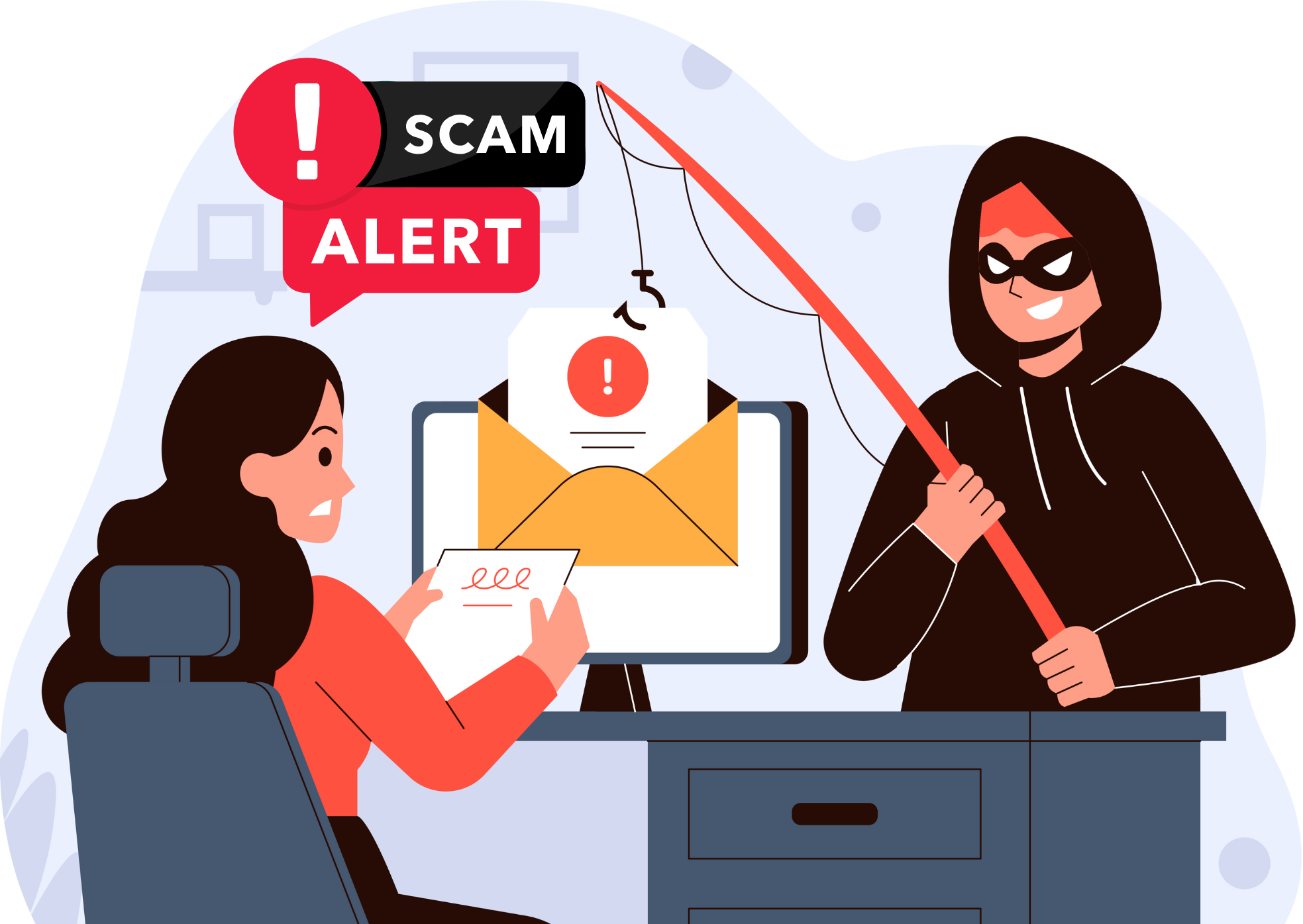
Criminals will message you claiming to be from the government and ask you to update your details or
complete an application to receive your Winter Fuel Payment. They’ll direct you to a fake government or energy website that looks just like the real thing.
The website will ask for your personal information and card details, which the criminals will use to make fraudulent payments. If you’re eligible for the Winter Fuel Payment, the government won’t text or email you. Most people that are eligible will get their payment automatically and receive a letter to confirm the amount. You can use the real government website to check if you are eligible.
Jan 30, 2026
According to a report by the AI Safety Institute, an organisation part of the Department for Science, Innovation and Technology aiming to evaluate and ensure the safety of users using AI, a third of adults AI for emotional support or social interaction. Additionally, one in 25 people turned to the tech for support or conversation. The report is based on two years of testing the abilities of more than 30 unnamed advanced AIs – covering areas critical to security, including cyber skills, chemistry and biology.
A survey by AISI of over 2,000 UK adults found people were primarily using chatbots like ChatGPT for emotional support or social interaction, as well as by voice assistants like Amazon’s Alexa. They also found that in a subreddit (an online forum on a website called Reddit) dedicated to discussing AI companions, people reported that when their chatbots went down, they described symptoms of withdrawal, such as feeling anxious or depressed, disrupted sleep and neglecting their responsibilities.
The report discussed various issues with such a mindset including the ability to sway people’s political opinions, with the most persuasive AI models delivering “substantial” amounts of inaccurate information in the process.
Additionally, over-reliance on AI might reduce opportunities for real human connection, leading to increased feelings of loneliness and social isolation. Studies have also found that a quarter of teenagers in the UK have turned to AI chatbots for mental health support in the last year.
Relying on chatbots as a primary, significant or only source of communication is bad for several reasons, including a reduction in human contact, which is bad for mental health and the occasional inaccuracies of what a chatbot says, which is followed on, could have serious consequences.
A chatbot isn’t designed to pick up on social cues and emotions-it’s just there to answer questions. So, relying on it for human interaction isn’t going to work because it isn’t programmed to understand how to do it in a way that is truly helpful. If you are having trouble related to interacting with others, it’s better to reach out to real individuals, ideally in real life or sometimes online although be careful, especially with the latter.
Sources:
BBC News – One in three using AI for emotional support and conversation, UK says
The Guardian – Third of UK citizens have used AI for emotional support, research reveals
The Independent – Experts issue warning over people forming ‘emotional bonds’ with AI chatbots
Jan 30, 2026
Hospitals, energy and water supplies and transport networks would be better protected from the threat of cyber-attacks under new laws that were introduced in Parliament on 12th November. The law, put forward by Science Secretary, Liz Kendall, comes after independent research revealed that shows the average cost of a significant cyber-attack in the UK is now over £190,000. This amounts to around £14.7 billion a year across the economy – equivalent to 0.5% of the UK’s GDP.
Additionally, The Office for Budget Responsibility has warned that a cyber attack on critical national infrastructure could temporarily increase borrowing by over £30bn – the equivalent of 1.1 per cent of the UK’s GDP. Therefore, it’s a no brainer that the security problem needs solving.
The proposed bill, named “The Cyber Security and Resilience Bill” would extend cyber security regulation to key digital and essential services such as healthcare, transport, energy, and water, including medium and large IT and cyber security suppliers for the first time. These organisations would be required to meet clear security standards, report serious cyber incidents quickly, and have strong plans in place to manage attacks.
Regulators would gain new powers to designate critical suppliers and enforce minimum security requirements across supply chains, backed by tougher, turnover-based penalties for serious breaches. The Technology Secretary would also be able to direct regulators and essential service providers to take proportionate action to prevent cyber threats that could affect UK national security.
The bill has received backing from many senior officials including National Cyber Security Centre CEO Dr Richard Horne, National Chief Information Security Officer for Health and Care at Department of Health & Social Care, Phil Huggins and Simon Sheeran, Head of Cyber Security Oversight at the UK Civil Aviation Authority, who’ve praised it as “a crucial step in better protecting our most critical services”, “(provide the ability to) help keep services available, protect data, and maintain trust in our systems in the face of an evolving threat landscape” and “This Bill will help improve cyber defences essential for maintaining the already very high safety standards in aviation”.
Sources:
Gov.uk – Tough new laws to strengthen the UK’s defences against cyber attacks on NHS, transport and energy
The Independent – New laws to bolster UK’s defences against cyber attacks on NHS, transport and energy
Data Protection Network – UK Cyber Security Bill introduced to Parliament
Jan 30, 2026
Elon Musk’s Grok, an AI assistant that can be accessed via his social media platform, X (formerly known as Twitter), has faced a variety of controversy, including being rigged by Elon to have a right leaning mindset, praising Naziism, as well as several completely plain incorrect statements such as that second hand smoke exposure “isn’t real” and former First Lady Michelle Obama is a man. Its latest controversy is that it is being used to generate deepfake (realistic, AI-generated media) sexualised images of real people. Users send real images of people and tell Grok remove their clothes and replace them with lingerie or bikinis. Grok is restricted from making people outright naked, but users can request that the clothes are replaced with strings or dental floss.
A large proportion of the people being targeted are young women including the Stranger Things star, Millie Bobby Brown and Ashley St. Clair, a conservative influencer and one of Musk’s 4 baby mothers. When the latter posted online to complain about the images, a flood of people she called “Elon acolytes” responded that if she didn’t like being undressed by Grok, she should simply log off. Various female victims have described feeling violated and dehumanised. Women’s rights campaigners, including Refuge, Women’s Aid and Womankind Worldwide, have said they are “deeply concerned” by the reports and that there are “dangerous” consequences for women and girls, including to their safety and mental health.
Elon and X’s response to this have been mostly two-faced. He’s stated on X that “Anyone using Grok to make illegal content will suffer the same consequences as if they upload illegal content”, but simultaneously re-shared generated images, mostly of young, thin women in revealing outfits. X has said it acts against illegal content, including child sexual abuse material, “by removing it, permanently suspending accounts, and working with local governments and law enforcement as necessary” but still many women report their photos are still on the site.
The UK Government and Ofcom have called on Musk and X to deal with the situation. Ofcom said it had
made “urgent contact” with Elon Musk’s company xAI and said it was investigating concerns Grok has been
producing “undressed images” of people. Liz Kendall, the Technology Secretary, has endorsed the
regulator’s actions, saying “It is absolutely right that Ofcom is looking into this as a matter of urgency and it
has my full backing to take any enforcement action it deems necessary.”
Sources:
BBC News – Elon Musk’s Grok AI image editing limited to paid users after deepfakes
BBC News – Government demands Musk’s X deals with ‘appalling’ Grok AI
Washington Post – X users tell Grok to undress women and girls in photos. It’s saying yes.
Dec 30, 2025
2 teenagers were charged by US Department of Justice and the Crown Prosecution Service in England in
connection to attacks on TfL in August 2024, which resulted in a data breach potentially affecting thousands of customers whose names, contact information and bank details was accessed. Thalha Jubair, a 19-year-old from East London, was also charged with computer fraud, wire fraud and money laundering in relation to more than 120 network intrusions and extortion involving 47 US entities. He’s believed to have extracted $115mil (around £85mil) in ransom from his victims. His accomplice, Owen Flowers, an 18-year old from Walsall, has been accused of conspiring with others to infiltrate and damage the networks of SSM Health Care and attempting to target Sutter Health’s networks. Both are alleged to be part of Scattered Spider, a US and UK based hacking group whose previous high-profile targets include the casino, Caesars Entertainment and UK shops M&S, Co-op and Harrods. If convicted, they could spend a minimum of 14 behind bars.
Sources:
The Telegraph: Teenagers charged over multi-million pound tfl cyber-attack
BBC News: Teenagers charged over Transport for London cyber attack
Financial Times: Briton charged in US and UK over major cyber attacks